
How To Do... Marketing for Musicians
I wanted to write down everything I know through my own experience of using emails to sell a product. This is written specifically with indie musicians in mind but would apply to most small businesses.
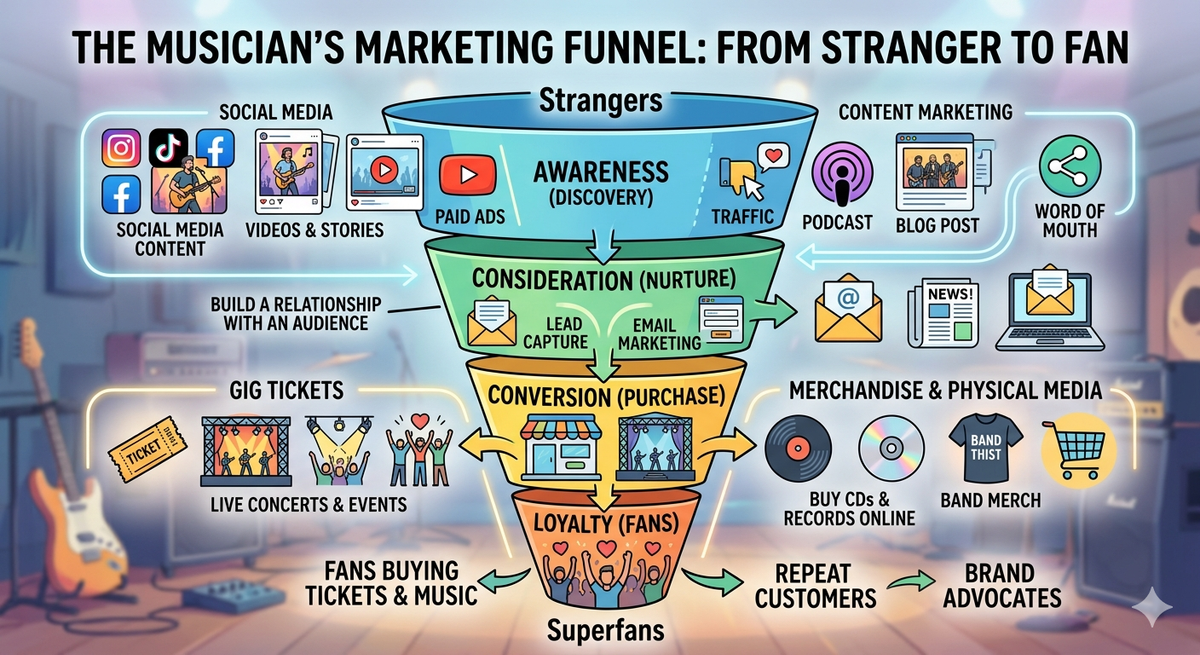
That's surely the first tip: you have to decide, today, whether music is your hobby or your job. This is the most important question and your most vital decision. If you want to make it your job, then you must start to see it as a small business.
Unfortunately, if art is your job, then you will need to start doing activities and making decisions based on profit rather than enjoyment. It is more nuanced than that, but the rule is simple. From now on, you only do something for one of two reasons: (1) it makes you money directly, today, or (2) it increases your exposure which will bring you money down the line, tomorrow.
Once you start labelling your activities into (1) makes money today or (2) might make money tomorrow, you can stop doing everything else. There is no third option. If it loses you money today, then maybe that's okay if it is something that will make you more money in future. But it is no longer okay to do something that just drains your energy and your bank account with no realistic prospect of it making money soon.
Your email list is the No. 1 resource of any small business from a sales and marketing perspective.
Email Marketing
The key resource you own (and you should start building today if you do not have one) is your email list. This is the No. 1 resource of any small business from a sales and marketing perspective. It is fully owned by you and is not tied to any platform. You can store it in a spreadsheet or in an email marketing tool, but you can always download it and move it somewhere else. It is your most precious resource and you are now going to devote your life to making it bigger.
Everything you do that is not 'making money today' is really about 'building out your email list'. Everything. By any means necessary. Give them a free song for signing up. Mail them a free postcard for signing up. Give them a sticker for signing up. But these are the rules: (1) you have to give them something for signing up that is totally free to them and (2) that something must not be a discount.
A discount is just a way to trick people into spending money. Discounts don't work on new fans. You must be genuinely offering something that they find valuable for free. Mailing out a postcard is very low cost to you but gets you their postal address as well as their email address and you will have a fan for life. If you know where your fans live you can use that information to plan tours.
I strongly believe you must use an email platform. It is very painful sending out manual emails from a spreadsheet and you risk your emails being flagged as spam. Worse, you risk accidentally sharing your fans' email addresses with other people, which is a massive data protection issue that might get you in real trouble.
Nearly all email platforms are free for the first 250 or 500 email addresses. This gives you an easy way to try out a couple and see what you find most logical. Kit is very popular. It is not the cheapest but it allows you to sell products and automate emails which will become important when your list grows. Mailer Lite is very simple to use and cheap.
The most important thing you can do today is to think about what you can use as an incentive for someone to join your list. You can make a digital download or you can use something you already have like some old merch that's been gathering dust. The cost to you should be $5 / £5 or less. If you can do something that costs you nothing, all the better. But your focus for the next three to six months is going to be building this list.
You can easily get to 25 subscribers by adding friends and family. They are going to be your main fanbase for a while. If you educate them about how crucial your email list is to your future, they will share it with their friends and you will be at 250 in no time. If you wish, you can flag these early fans with a label in your email platform and make sure you reward them when you hit the big time.
Social Media
Let's address the elephant in the room, the one most of you only do because you're told you have to. I am not here to deny that this is an essential part of your funnel. But it is by no means the most important part. I hear a lot of advice thrown out by 'music industry experts' who have little to no business experience outside of music. They mean well, most of them, but they're nearly all wrong most of the time.
You do need to be on social media because most of your audience will be and because you don't want someone else squatting on your profile name. It is very boring but very good practice to just create an account on every social platform you ever heard of, especially the newer ones, because you don't want someone else taking your name. This does not mean you need to be active there. Just set up a profile, fill out the link section to your Linktree or website, add a photo, and logout. Maybe make one post. Then logout.
Social media is a very low risk, low friction way for fans to find out about you for the first time, and to keep in touch with your big achievements such as song releases or tour plans. You do not need to post every day and you can use built-in (free) tools to schedule posts a week or more in advance.
You are now running a business and it is perfectly fine to use business practices to spare more time for your actual music. Every single business, even the small ones, use a social media scheduler which gives you one interface to all your social profiles, all in one place. These do cost money but there are free options.
But this is the key piece of advice. Your social media presence serves two purposes only: (1) it is a shop window to let people hear about you and hopefully they will stream your music and (2) to get people to join your email list. Period. Everything you do online that is not directly making money is designed to get people to sign up to your email list. That's it.
Music Streaming
The music streaming services are just another form of social media. They are there for you to get exposure and to help your fans hear your music to see if they like it. You will not make any money off streaming. Streaming is a 'money tomorrow' activity that you should view as a free marketing platform.
When I say it is basically just social media I mean that it is a low friction, low risk and free way to build a following. People will listen to you and they will decide whether they love your music and how much. But you will never make money off these fans. The vast majority of them will be casual listeners who have no intention of buying gig tickets or merch. They are still beautiful. But they are not your customers. Customers are people who give you actual money, not some third party tech platform.
Text Messages
Expensive and fiddly to set up but experiencing a resurgence. Since most people only use their SMS app for receiving parcel notifications, texts have become a low friction way to update fans without irritating them. Even better, in the USA and some countries you can use their area codes to route your next tour.
Direct Digital Sales
You must have a way for fans to buy digital music direct from you. There are many options but Bandcamp is the most famous. You can only build an international fanbase if you help your fans find and buy your digital music due to postage costs and customs restrictions.
Patreon / Substack
Some artists find success with paid membership platforms like Patreon, which is perfect for musicians, or even Substack, for those of you who like to write prose. They should be a planned part of your business, but you get to decide how big a part of your business they are. Every activity you do costs you time and may cost you money on top. If you decide to do a membership community, you really need to show up for that community and over-deliver. If you cannot commit, better to avoid.
Crowdfunding
Excellent for one-off projects that deliver a saleable output, like an album or even a single. Your top fans will desperately want to help you cover your recording costs. But this is not a way to generate ongoing, recurring revenue every month.